My daughter, who is in first grade at a Reform Jewish day school, recently told her teacher that her parents said she doesn't have to wear a kippah during tefilah (prayer services) at school. I received an email asking if this was in fact the case, and I was shocked. [A note of background--my husband is the rabbi for the school. As a Reform school, it walks a fine line when it comes to some ritual practices. The kippah policy is that middle schoolers may choose, but elementary students will wear during tefilah unless they have a parent's permission not to.]
As a woman rabbi who wears a kippah when I am in prayer services, communal events, and other specifically Jewish and/or rabbinic moments, I was amazed that MY daughter would not want to wear a kippah. Setting aside that I was a little hurt she didn't want to be like her mommy, I was surprised that I would need to make a case for wearing a kippah to my own daughter. I get asked about my kippot almost weekly. It's usually not a question about the kippah itself, but something like, "Hey, I didn't know women wore those," or "Wait, you're a rabbi? I didn't know women could be rabbis/haven't ever met a woman rabbi before/how long have women been rabbis?" Thus, my kippah is a symbol of my ability to stand on the shoulders of the courageous women who have come before me in pursuing visible equality in our Jewish community, and a reminder of my sacred calling not only as a Jew, but a Jewish woman and a rabbi. The kippah is often a lot more than just a headcovering.
When I was 10, we moved to a new city and congregation and a woman rabbi (the congregation's first) had also just started in the community. She unapologetically wore a kippah and tallit and it was revolutionary for my mother and many like her because it gave them permission to try it out and claim this ritual practice as their own. Incidentally, my mother began to make kippot and wore them any time she was in the synagogue, but would not let me wear pants on the bimah (a blog for another time). Both of these shaped me--I wear a kippah in the situations I described earlier and I still don't wear pants when leading services.
Hearing the news that my daughter did not want to wear a kippah felt like a rejection of all of these things...but she's six years old and even more, she cannot reject that which I have not yet taught her.
So, my daughter will be wearing a kippah at services--she does not get an exemption from her parents at this point. But she does get to choose what kind of kippah she wants to wear, and has selected one that is bejeweled with rhinestones. Even more importantly, I am now talking to her about what it means to me to have her try this now, while she is young and we are responsible for her Jewish practice, so she has the information later when it is up to her to decide. And just as I talk about the progress women have made and need to make in so many ways, I will tell her more about my story, and her grandmother's story, and how we are all working towards a day when a woman wearing a kippah or being a rabbi isn't such a surprise!
Wednesday, January 24, 2018

Saturday, December 16, 2017
A Jew Remembers Christmas
This year, I've been thinking about Christmas more than usual. My father died five months ago, and because he was only officially Jewish for the last ten years of his life our family celebrated a secular Christmas. For the last ten years, we were rarely together on Christmas Day but by phone, we'd fondly remember the stories of one of my father's favorite holidays of the year, telling stories of our childhood. Without him here, it feels like these stories won't be the same.
As a rabbi who works with interfaith couples, I often validate that Christmas has a lot of appeal because I know from my childhood how fun it can be with the various traditions and customs that exist. It seems everyone is getting ready to celebrate Christmas, there are lights and cookies and presents and music and--except at the mall--people seem to be happier than usual. For those who do not celebrate it, this time of year can feel isolating. And for those who, like me and my family for the last ten years and counting, no longer celebrate Christmas, there is a special type of nostalgia of knowing what we used to do, and making this day and season something different.
In that spirit, a few reflections of things I have come to realize about Christmas (and holiday traditions overall) that may be of particular interest to those feeling a little nostalgia or envy at this time of year:
Holiday traditions often transcend religion: The things that make a holiday special are rarely only religious in nature. Perhaps it is the friends who have become like our family (meaning they know how wacky we are but still share holidays with us!), the decorating of a house, the custom that becomes tradition that becomes ritual carries power. For example, we had the custom of a fancy Christmas Eve dinner at home. Each year on December 24, I often cook something a little fancy just because it's what we used to do--and is a family tradition, not a religious one. As we had close family friends with whom we used to always spend Christmas (and many a Thanksgiving too), I have made sure we have a tradition to getting together with close friends during Chanukah so our kids will also have a sense of tradition of being with friends, not just family. In Judaism, with the many home rituals that accompany holidays, we have many ways to make holiday traditions through food and community.
A little anticipation goes a long way: I believe this year Costco had Christmas decorations in the store the same week as Yom Kippur. Whether one observes the advent or not, there is a sense of anticipation and preparation for December 25. I can remember the various stages of Christmas in my childhood: getting and decorating the tree (and protecting it from the cat), pulling the ugly holiday mugs down from storage and using them for a month, decorating the house, holiday concerts, playing carols at holiday parties (great money, by the way), shopping and wrapping, etc. It was fun and everyone was in it together. Let me assure you, we can create that same anticipation for almost any holiday. As Jews, we also have our own preparatory periods. The month leading up to Rosh Hashanah is a time of spiritual reflection, and the month leading up to Passover is a time of cleaning, cooking, and yes, some spiritual reflection thrown in there too. While there is no religiously-prescribed Chanukah preparations, if we are looking to be in the "holiday spirit" we can create a sense of anticipation in our families in many parallel ways to those celebrating Christmas: decorating our homes (we put our Chanukah menorahs on display, and a few twinkle lights around the house--some of which also make an appearance in our sukkah in the fall), planning activities and extending invitations for Chanukah parties, and more.
Don't play the "Chanukah is just as cool" game: I actually believe that for interfaith families who have a Christmas celebration, whether at home or with extended family, this time of year can be easier because there isn't an envy of those celebrating Christmas. For those of us who don't have that, we might be tempted to try to make Chanukah as elaborate as what we perceive is happening around us. Yet, let's not play into that pressure. Chanukah is fundamentally about pride in being Jewish, miracles, rededication. On the list of holiday significance, it is far below many others such as our festivals and high holy days. Outside of the United States, Chanukah is much less of a deal and gift giving in particular is minimal. Make Chanukah meaningful in its own right, not a competition. Remind our children that we have a lot of holidays that are opportunities for fun, food, family, and friends. Give them the tools to explain to those who are not part of the Jewish community what Chanukah is (and is not) so they feel empowered at this time of year. Do the traditions of Chanukah, but be cautious about appropriating things that are really just "Jewish Christmas" decorations. We have actually moved some of our gift giving to our children to other holidays to remove some of the pressure at this time of year.
Embrace the generosity of the season: The end-of-year charitable contribution season and the December holiday season are times where people are in a more giving spirit overall. This is a great way to bridge the divide between "Team Chanukah" and "Team Christmas" by volunteering, donating, and otherwise giving back to our communities and helping those in need.
Whatever this time of year means for you and your family, I hope that you have a meaningful and joyous holiday season. Remember that whatever you do this year can become the stories of years to come, and all of us have traditions, joy, and meaning to share.
As a rabbi who works with interfaith couples, I often validate that Christmas has a lot of appeal because I know from my childhood how fun it can be with the various traditions and customs that exist. It seems everyone is getting ready to celebrate Christmas, there are lights and cookies and presents and music and--except at the mall--people seem to be happier than usual. For those who do not celebrate it, this time of year can feel isolating. And for those who, like me and my family for the last ten years and counting, no longer celebrate Christmas, there is a special type of nostalgia of knowing what we used to do, and making this day and season something different.
In that spirit, a few reflections of things I have come to realize about Christmas (and holiday traditions overall) that may be of particular interest to those feeling a little nostalgia or envy at this time of year:
Holiday traditions often transcend religion: The things that make a holiday special are rarely only religious in nature. Perhaps it is the friends who have become like our family (meaning they know how wacky we are but still share holidays with us!), the decorating of a house, the custom that becomes tradition that becomes ritual carries power. For example, we had the custom of a fancy Christmas Eve dinner at home. Each year on December 24, I often cook something a little fancy just because it's what we used to do--and is a family tradition, not a religious one. As we had close family friends with whom we used to always spend Christmas (and many a Thanksgiving too), I have made sure we have a tradition to getting together with close friends during Chanukah so our kids will also have a sense of tradition of being with friends, not just family. In Judaism, with the many home rituals that accompany holidays, we have many ways to make holiday traditions through food and community.
A little anticipation goes a long way: I believe this year Costco had Christmas decorations in the store the same week as Yom Kippur. Whether one observes the advent or not, there is a sense of anticipation and preparation for December 25. I can remember the various stages of Christmas in my childhood: getting and decorating the tree (and protecting it from the cat), pulling the ugly holiday mugs down from storage and using them for a month, decorating the house, holiday concerts, playing carols at holiday parties (great money, by the way), shopping and wrapping, etc. It was fun and everyone was in it together. Let me assure you, we can create that same anticipation for almost any holiday. As Jews, we also have our own preparatory periods. The month leading up to Rosh Hashanah is a time of spiritual reflection, and the month leading up to Passover is a time of cleaning, cooking, and yes, some spiritual reflection thrown in there too. While there is no religiously-prescribed Chanukah preparations, if we are looking to be in the "holiday spirit" we can create a sense of anticipation in our families in many parallel ways to those celebrating Christmas: decorating our homes (we put our Chanukah menorahs on display, and a few twinkle lights around the house--some of which also make an appearance in our sukkah in the fall), planning activities and extending invitations for Chanukah parties, and more.
Don't play the "Chanukah is just as cool" game: I actually believe that for interfaith families who have a Christmas celebration, whether at home or with extended family, this time of year can be easier because there isn't an envy of those celebrating Christmas. For those of us who don't have that, we might be tempted to try to make Chanukah as elaborate as what we perceive is happening around us. Yet, let's not play into that pressure. Chanukah is fundamentally about pride in being Jewish, miracles, rededication. On the list of holiday significance, it is far below many others such as our festivals and high holy days. Outside of the United States, Chanukah is much less of a deal and gift giving in particular is minimal. Make Chanukah meaningful in its own right, not a competition. Remind our children that we have a lot of holidays that are opportunities for fun, food, family, and friends. Give them the tools to explain to those who are not part of the Jewish community what Chanukah is (and is not) so they feel empowered at this time of year. Do the traditions of Chanukah, but be cautious about appropriating things that are really just "Jewish Christmas" decorations. We have actually moved some of our gift giving to our children to other holidays to remove some of the pressure at this time of year.
Embrace the generosity of the season: The end-of-year charitable contribution season and the December holiday season are times where people are in a more giving spirit overall. This is a great way to bridge the divide between "Team Chanukah" and "Team Christmas" by volunteering, donating, and otherwise giving back to our communities and helping those in need.
Whatever this time of year means for you and your family, I hope that you have a meaningful and joyous holiday season. Remember that whatever you do this year can become the stories of years to come, and all of us have traditions, joy, and meaning to share.
Friday, July 1, 2016
There Are More Than Four Questions
My daughter is learning the Four Questions in pre-K in preparation for Passover. She is very excited about the upcoming holiday, eagerly singing songs like "Where is Baby Moses?" and "Frogs on Pharaoh's Head." Yet, there are clearly more than four question floating around for her. When she learned about a few of the plagues, she asked why the plagues happened to everyone when Pharaoh was the one who made bad choices. The next morning the question was how God didn't burn when God was in the burning bush. Then why Moses was in the river Nile.
To try to concretize some of the story, I showed her the movie "The Prince of Egypt." This film is beautifully done and helped facilitate some conversation around parts of the Passover and Exodus story. What the movie also did, though, is show the pain of the plagues as they were inflicted on the Egyptians. By the time the Israelites emerge on the other side of the Sea of Reeds watching Pharaoh's army drowning in the sea, one is left with a bittersweet feeling.
While I understand that we want to be age-appropriate with our children and help them to see the fun and joy in the festival of Passover, I would also encourage us to remember that we have a responsibility to be honest about the power and questions the story raises. Amidst plague masks and toys is a dark story of an entire nation being punished by Pharaoh's hardened heart, which is in part hardened to ensure the Israelites are clearly delivered by God, reminding us that freedom can come at a price. Amidst the songs and the foods is a deep question of what it means to be free in our time, not just in that Exodus story. I would offer that most children can find some degree of that understanding, and we as adults should push ourselves to reflect on the deep meanings and questions of this festival.
As we approach our family's seder, we are certainly focusing on the joys--the food, the family, the singing, and especially my daughter's "Four Questions" debut. And, we will encourage her to offer her many other questions along the way, because each of us at every age is supposed to find meaning in the seder, the story, and feel it applies to them.
As you approach your seder, may it be one of many questions, because that is how we learn, that is how we grow, and that is how we will continue to find meaning in this Festival of Passover, the time of our freedom and celebration.
To try to concretize some of the story, I showed her the movie "The Prince of Egypt." This film is beautifully done and helped facilitate some conversation around parts of the Passover and Exodus story. What the movie also did, though, is show the pain of the plagues as they were inflicted on the Egyptians. By the time the Israelites emerge on the other side of the Sea of Reeds watching Pharaoh's army drowning in the sea, one is left with a bittersweet feeling.
While I understand that we want to be age-appropriate with our children and help them to see the fun and joy in the festival of Passover, I would also encourage us to remember that we have a responsibility to be honest about the power and questions the story raises. Amidst plague masks and toys is a dark story of an entire nation being punished by Pharaoh's hardened heart, which is in part hardened to ensure the Israelites are clearly delivered by God, reminding us that freedom can come at a price. Amidst the songs and the foods is a deep question of what it means to be free in our time, not just in that Exodus story. I would offer that most children can find some degree of that understanding, and we as adults should push ourselves to reflect on the deep meanings and questions of this festival.
As we approach our family's seder, we are certainly focusing on the joys--the food, the family, the singing, and especially my daughter's "Four Questions" debut. And, we will encourage her to offer her many other questions along the way, because each of us at every age is supposed to find meaning in the seder, the story, and feel it applies to them.
As you approach your seder, may it be one of many questions, because that is how we learn, that is how we grow, and that is how we will continue to find meaning in this Festival of Passover, the time of our freedom and celebration.
Thursday, June 30, 2016
Mommy at the Mikvah
The first time I went to the mikvah it was before my wedding. I am a Reform Jew and mikvah was not really on my radar until preparing for my wedding as a rabbinical student (with a newfound awareness of all kinds of rituals). With my mother and other important women in my life blessing me, I immersed in a beautiful mikvah in Pittsburgh and never imagined I would do so again. Years later, I considered immersing as part of my pregnancy journey but hesitated because there was no mikvah in Atlanta where I felt I could go anonymously and comfortably as a rabbi in the community.
In November 2015, we opened MACoM: Metro Atlanta Community Mikvah, a mikvah designed to be welcoming and inclusive of our diverse Jewish community. I am on the board, a committee or two, and the clergy advisory group, so I knew most of the inner workings of this mikvah. However while I thought I might want to use it occasionally, I never thought about becoming a regular user: until I finally went and discovered this was the ritual I did not know I needed.
I would ask my fellow parents, particularly of young children, this question: When is the last time you heard silence? Our lives are constant refrains of "Mommy" and "Daddy," phone calls, bedtime stories, questions, requests. Even the night isn't silent with the white noise of the baby monitor.
When I went into the mikvah, it was silent. There were no requests, no questions, no calls...just silence. It was disturbing for one moment and then completely soothing. As I went under the water, time slowed down and everything paused.
As parents, there is the feeling that the days are long but the weeks, months, and years are short. We have milestone transitions such as the start of a new school year or a birthday. The day-to-day rushes past with the sweet moments that seem memorable until they are replaced by the next.
Mikvah offers parents--both men and women--an opportunity to pause. Much like the havdalah ceremony at the end of Shabbat, we draw out the time into a meaningful ritual transition. The preparations for the mikvah slow us down, the immersion in a quiet pool invites us to be still with our thoughts. We can make the mikvah experience an opportunity to think about the past month and intentionally go into the next one, reflecting on our many roles, joys, and challenges in the frame of Jewish ritual. Whether going monthly or in another increment of time, we can take a deep breath and emerge renewed, ready to enter back into the noise and see what comes next.
In November 2015, we opened MACoM: Metro Atlanta Community Mikvah, a mikvah designed to be welcoming and inclusive of our diverse Jewish community. I am on the board, a committee or two, and the clergy advisory group, so I knew most of the inner workings of this mikvah. However while I thought I might want to use it occasionally, I never thought about becoming a regular user: until I finally went and discovered this was the ritual I did not know I needed.
I would ask my fellow parents, particularly of young children, this question: When is the last time you heard silence? Our lives are constant refrains of "Mommy" and "Daddy," phone calls, bedtime stories, questions, requests. Even the night isn't silent with the white noise of the baby monitor.
When I went into the mikvah, it was silent. There were no requests, no questions, no calls...just silence. It was disturbing for one moment and then completely soothing. As I went under the water, time slowed down and everything paused.
As parents, there is the feeling that the days are long but the weeks, months, and years are short. We have milestone transitions such as the start of a new school year or a birthday. The day-to-day rushes past with the sweet moments that seem memorable until they are replaced by the next.
Mikvah offers parents--both men and women--an opportunity to pause. Much like the havdalah ceremony at the end of Shabbat, we draw out the time into a meaningful ritual transition. The preparations for the mikvah slow us down, the immersion in a quiet pool invites us to be still with our thoughts. We can make the mikvah experience an opportunity to think about the past month and intentionally go into the next one, reflecting on our many roles, joys, and challenges in the frame of Jewish ritual. Whether going monthly or in another increment of time, we can take a deep breath and emerge renewed, ready to enter back into the noise and see what comes next.
Wednesday, April 20, 2016
The Family Seder
Some of my earliest Jewish memories are from Passover. I vaguely recall, as a very young child, watching Grandpa Hurwitz cough while eating horseradish root (or, because my mother retells it to me, it feels like I was there). I remember learning the piano chords to the Four Questions and then proudly playing them at my Great Aunt Lenore's home when we all gathered for seder one year. I remember a seder at my Grandma Irene's home in Florida, dusting off the dishes she never used.
But most of all, I remember the seder as it usually was, in our home growing up. It was a remarkable blend of the intentional and the unintentional. Recipes were handed down, but not discussed with any fanfare. China was from my parents' wedding, but when we had more than 10 people, interspersed was my great-grandmother's china (a floral pattern my mother hated). After her death, we used my grandmother Julia's silver, which as a Ukranian Catholic she never could have envisioned happening at a seder, but we also had plenty of plastic forks and plates around. The haggadah was just the one we happened to have, one with a burned corner where a guest had accidentally set fire to it from one of the decorative votives on the table. The matzah cover was a horribly ugly blue felt creation from my brother's early religious school years that was somehow gorgeously meaningful in its weirdness. You get the idea.
We didn't think too hard about the actual content of the seder. We knew we'd do it all in some form or fashion, but there were never plague bags or gimmicks to make it flow. We'd read, each person in their turn, and then we'd eat. We'd talk some more, and then we'd go to bed. I recall the first year, as an aspiring rabbi, I was given the role of introducing the seder. I wrote a d'var Torah about the meaning of freedom (I wish I still had it now) and proudly set the stage for what the festival meant to me, and to us, in that space.
I believe it has been a decade since I have been in Pittsburgh for a seder. It's been years since the last family seder Micah and I experienced, in Las Vegas in 2008. Usually we spend Passover in a community we have created through our rabbinates. The first night usually at The Temple, the second night with couples whose weddings and conversions I officiate.
I find myself each year yearning to make our Passover authentic. Somehow the seven days pass so much faster than they did when I was younger. before we know it, we can eat bread again. I almost miss it by the end. Micah and I spend time talking about the seder, ways to make it creative, and in that way we find our authentic seder voice (one more scripted, one more spontaneous). I often feel we could do more in this festival, but that is an ongoing journey.
Now, with children of our own, we have another growing edge. We are taught about the Four Children: wise, wicked, simple, and unable to ask. We know that we are all of these children in some way.
In our daughter and son, we have these children looking at us in anticipation of being taught. It is no longer abstract. To our five year old's wise questions, we try to answer from our own faith and uncertainty. To our children's simple questions, we answer easily. To their wicked moments (of which there are few), we try to respond with compassion. And, for all that they are unable to ask, we model our own commitment.
When thinking about Passover this year, something in me yearned for a different experience. While I can tell you the practical reason we are traveling for Pesach this year is because we did not take vacation time at winter break, there is a spiritual reason. I knew, deep down, that we need to have a family seder. Our children need to make a memory that is organic, drawn from the deep connections that exist in a family, not just created by their rabbi parents and Temple community. They need to have the experience of learning that which is not always explictly spoken--that for some reason even the least religious of us are drawn to a ritual that has been handed down from generation to generation, that somehow we find a new meaning embedded in the parsley, matzah, and this year, Grandma's brisket.
I think about this weekend and am brought to tears by the image that our children will experience something powerful beyond words: a seder table filled with family members they already know well. Four generations will gather together and say that we are proudly Jewish and connected to our people, and say that we are lovingly connected to one another as well. In that moment, it does not matter what parts of the liturgy we do or forget, or what tunes we do, or whether things are like they are at home. What matters is that we come together and give ourselves the gift of a night to remember.
But most of all, I remember the seder as it usually was, in our home growing up. It was a remarkable blend of the intentional and the unintentional. Recipes were handed down, but not discussed with any fanfare. China was from my parents' wedding, but when we had more than 10 people, interspersed was my great-grandmother's china (a floral pattern my mother hated). After her death, we used my grandmother Julia's silver, which as a Ukranian Catholic she never could have envisioned happening at a seder, but we also had plenty of plastic forks and plates around. The haggadah was just the one we happened to have, one with a burned corner where a guest had accidentally set fire to it from one of the decorative votives on the table. The matzah cover was a horribly ugly blue felt creation from my brother's early religious school years that was somehow gorgeously meaningful in its weirdness. You get the idea.
We didn't think too hard about the actual content of the seder. We knew we'd do it all in some form or fashion, but there were never plague bags or gimmicks to make it flow. We'd read, each person in their turn, and then we'd eat. We'd talk some more, and then we'd go to bed. I recall the first year, as an aspiring rabbi, I was given the role of introducing the seder. I wrote a d'var Torah about the meaning of freedom (I wish I still had it now) and proudly set the stage for what the festival meant to me, and to us, in that space.
I believe it has been a decade since I have been in Pittsburgh for a seder. It's been years since the last family seder Micah and I experienced, in Las Vegas in 2008. Usually we spend Passover in a community we have created through our rabbinates. The first night usually at The Temple, the second night with couples whose weddings and conversions I officiate.
I find myself each year yearning to make our Passover authentic. Somehow the seven days pass so much faster than they did when I was younger. before we know it, we can eat bread again. I almost miss it by the end. Micah and I spend time talking about the seder, ways to make it creative, and in that way we find our authentic seder voice (one more scripted, one more spontaneous). I often feel we could do more in this festival, but that is an ongoing journey.
Now, with children of our own, we have another growing edge. We are taught about the Four Children: wise, wicked, simple, and unable to ask. We know that we are all of these children in some way.
In our daughter and son, we have these children looking at us in anticipation of being taught. It is no longer abstract. To our five year old's wise questions, we try to answer from our own faith and uncertainty. To our children's simple questions, we answer easily. To their wicked moments (of which there are few), we try to respond with compassion. And, for all that they are unable to ask, we model our own commitment.
When thinking about Passover this year, something in me yearned for a different experience. While I can tell you the practical reason we are traveling for Pesach this year is because we did not take vacation time at winter break, there is a spiritual reason. I knew, deep down, that we need to have a family seder. Our children need to make a memory that is organic, drawn from the deep connections that exist in a family, not just created by their rabbi parents and Temple community. They need to have the experience of learning that which is not always explictly spoken--that for some reason even the least religious of us are drawn to a ritual that has been handed down from generation to generation, that somehow we find a new meaning embedded in the parsley, matzah, and this year, Grandma's brisket.
I think about this weekend and am brought to tears by the image that our children will experience something powerful beyond words: a seder table filled with family members they already know well. Four generations will gather together and say that we are proudly Jewish and connected to our people, and say that we are lovingly connected to one another as well. In that moment, it does not matter what parts of the liturgy we do or forget, or what tunes we do, or whether things are like they are at home. What matters is that we come together and give ourselves the gift of a night to remember.
Thursday, February 11, 2016
Giving Thanks for Strep
Yesterday came the call every working parent dreads: "Your daughter has a fever and you need to pick her up." We immediately went into emergency-preparedness mode, shuffling to make sure she got to the doctor and making plans to have her home the next day. Fortunately, we received the diagnosis of strep throat which, unlike what I call the "$40 virus" (named for the doctor's copay), is treatable with antibiotics and improves almost immediately. She will be in school on Friday, hurray. And, she got sick at the best possible time because I am off on Thursdays.
Yet Thursdays are my day to get stuff done. So, this morning as my daughter perkily ate breakfast after her second dose of antibiotics, I was calculating how many of my plans for today were in the trash. Certainly the things that are just for me, like a good long run, were off the table, as was my introvert time folding laundry over television. Powering through five errands at once? Unlikely. And as my mood started to tip off the precipice into grumpiness...two little arms reached around me and said, "Mommy, I'm so excited to have a day just with you."
In that moment, the grumpiness was erased. What a gift, as someone who usually works on six days of the week, to have a full day with my daughter and enjoy time together. My daughter proceeded to inform me that we were going to have a girls' day because her brother would be at school. Since she was fever-free and chipper, we found ourselves out and about doing some of the errands on my list.
Today I learned that my daughter loves shopping. I knew it in the abstract, but never had the patience (or time) to watch her discovering the numerous useless items of kitsch that can be found in Bed, Bath, and Beyond while searching for the one item you actually need. Ladybug timers! Egg cups shaped like eggs! Odor-eliminating beads that glittter! Fruit snacks! When we passed the nail polish, she asked what I thought about doing manicures, and we each picked a new color for our polish collection. Then, we went to DSW to pick out the hiking shoes my family is giving me for my upcoming birthday. I always wondered who on this planet would buy the gaudy shoes in the clearance section...and now I know that person is my daughter! She excitedly found shoes in my size, trying to convince me that I could use a floral-printed, rhinestone-enhanced, four-inch pair of heels, or rhinestone-covered flats, or maybe a fuschia purse.
There is tremendous joy in hearing my daughter's imagination and energy in the hours which are usually spent at school. Today I was the one listening to made-up songs, conversations with stuffed animals, and the questions that popped into her mind. I don't have to ask about her day when she's tired--I've had the pleasure of experiencing it with her. She kept telling me, "It's fun to have a girls' day, Mommy." Why yes, my love, it is. Clearly you and I both needed it. Next time, let's do it without the strep throat!
Sunday, August 16, 2015
Mommy, what is a racist?
Last week, The Temple hosted marchers for the NAACP's Journey for Justice, a march from Selma to Washington to draw attention to injustice and inequality. Over 140 Reform Rabbis are participating in the march, carrying the Torah as a symbol of our commitment to the pursuit of justice for everyone.
Outside of our social hall, we displayed large photographs of the bombing of The Temple and of our late Rabbi emeritus Jacob Rothschild with Dr. Martin Luther King. Walking past these photographs, my daughter asked me, "Who broke The Temple?" I took her to the other photograph and reminded her of Martin Luther King and his dream of equality. Then, I said, "Bad men didn't like that The Temple believed this too, and they broke The Temple." She asked, "Who were the bad men?" And I said, "They were racist." "But Mommy, what's a racist?"
It is tempting to say to my four year old that I'll tell her when she's older. After all, why draw attention to race at a time when she barely notices these things? Yet, there are many children out there who do not sit in a place of privilege, whose reality already includes difficult truths about how our society works for some, and not others, on the basis of race.
Yesterday, I marched with the Journey for Justice and my children joined me for a part of it. The leaders of the march encouraged all of the children (we had eight "Rabbis' kids" there) to be up near the front. At first I said we didn't need to do that, they weren't there to draw attention to themselves. But then someone explained to me that we were walking through rural Georgia, we were expecting some nasty comments, and it was safest for our children to be near the front. Later that day, we had two African-American children, ages 4 and 6, and they too were walking up front because that was the place they could be most protected.
This is the difficult truth--that for as simple as it seems to us to treat people with dignity and respect and to see and respond to the injustices that exist, there are still plenty of people in this world who don't or won't see them. I walked next to a young man from Texas who was marching because he was denied the right to vote in a recent election. We talked about children and he asked how I explained racism to my daughter. I said, "There are people in this world who don't like people simply because they look different from them." We then talked about raising our children to be a generation who know from the earliest ages how to treat others and bring about goodness in this world. If we teach them from the beginning love and pursuit of justice, they won't know any differently.
I have added the photo of my children "strolling" through the march to their photostreams. One day, they will look at this picture, alongside Pride Parades and Hunger Walks, and know that even before they really understood, they were being taught to pursue justice. And I will tell them that alongside us were people who wanted the same thing for their children that I do for mine: a peaceful, safe home, access to food and healthcare and quality education, a strong community, and the ability to pursue their dreams and potential to the fullest. Kein yehi ratzon--may it be God's will, and may it be ours.

Outside of our social hall, we displayed large photographs of the bombing of The Temple and of our late Rabbi emeritus Jacob Rothschild with Dr. Martin Luther King. Walking past these photographs, my daughter asked me, "Who broke The Temple?" I took her to the other photograph and reminded her of Martin Luther King and his dream of equality. Then, I said, "Bad men didn't like that The Temple believed this too, and they broke The Temple." She asked, "Who were the bad men?" And I said, "They were racist." "But Mommy, what's a racist?"
It is tempting to say to my four year old that I'll tell her when she's older. After all, why draw attention to race at a time when she barely notices these things? Yet, there are many children out there who do not sit in a place of privilege, whose reality already includes difficult truths about how our society works for some, and not others, on the basis of race.
Yesterday, I marched with the Journey for Justice and my children joined me for a part of it. The leaders of the march encouraged all of the children (we had eight "Rabbis' kids" there) to be up near the front. At first I said we didn't need to do that, they weren't there to draw attention to themselves. But then someone explained to me that we were walking through rural Georgia, we were expecting some nasty comments, and it was safest for our children to be near the front. Later that day, we had two African-American children, ages 4 and 6, and they too were walking up front because that was the place they could be most protected.
This is the difficult truth--that for as simple as it seems to us to treat people with dignity and respect and to see and respond to the injustices that exist, there are still plenty of people in this world who don't or won't see them. I walked next to a young man from Texas who was marching because he was denied the right to vote in a recent election. We talked about children and he asked how I explained racism to my daughter. I said, "There are people in this world who don't like people simply because they look different from them." We then talked about raising our children to be a generation who know from the earliest ages how to treat others and bring about goodness in this world. If we teach them from the beginning love and pursuit of justice, they won't know any differently.
I have added the photo of my children "strolling" through the march to their photostreams. One day, they will look at this picture, alongside Pride Parades and Hunger Walks, and know that even before they really understood, they were being taught to pursue justice. And I will tell them that alongside us were people who wanted the same thing for their children that I do for mine: a peaceful, safe home, access to food and healthcare and quality education, a strong community, and the ability to pursue their dreams and potential to the fullest. Kein yehi ratzon--may it be God's will, and may it be ours.
Thursday, July 9, 2015
Don't Sweat the Small Stuff
Today we found ourselves in Jerome, Arizona, as part of our family vacation with my in-laws and my husband's brother and his family. It was here that I learned the hard lesson of what it means to be the parent I want to be.
My mother-in-law decided to stop in a little jewelry store to buy my daughter a ring. The souvenir rings they bought in Sedona were quite large on a four year-old's finger, and this shop had some child-sized rings. We tried on several before deciding on a turquoise and silver ring--total price of $21. It was slightly loose, but seemed to be a better choice than the other ring which fit almost too tightly.
As we were walking out of the shop, I asked my daughter to say a big thank you to her grandmother. As I was about to add the next logical sentence--be sure not to lose this special present--my mother-in-law hugged my daughter and said, "Just so you know, if you lose this, I won't be angry. Accidents happen, and I don't want you to be afraid to tell me. This is just a little present."
I stopped in my tracks--how did she know what I was about to say? Immediately the many things I have lost came back to me, particularly the memory of the first thing my parents were angry with me for losing--one of the 14K gold earrings that I was given when I was eight.
Of course I want my daughter to treat her possessions carefully. We don't replace things that get broken or lost when these things happen out of carelessness, and we often have to explain that things sometimes cannot be replaced (or at least not immediately). Yet, this was a reminder that she is only four years old, and this was my opportunity to remember that I can help her preemptively be forgiving of that fact. As my mother-in-law said, accidents can happen.
And ten minutes later, while sitting at a barbecue restaurant, we discovered the ring had slipped off her finger and was nowhere to be found. I was so frustrated. In my gut, I wanted to yell at my daughter, "How could you be so careless?" And in my mind, I remembered being an eight year old girl on the other side of this. Yet the battle between instinct and aspiration was almost insurmountable, and all over a $20 ring.
I asked my daughter to apologize to her grandma for accidentally losing this ring. Grandma said it was fine, and then the two of them walked over to the server to leave our phone number in case it turned up. In the course of the conversation, in which my daughter was in tears, the server gave her a Hello Kitty keychain. This Hello Kitty hung in the rearview mirror of her car which was totaled in a car accident back in May. This woman, a young mother of two, was ejected from her car and should have been killed, but she, her friend, and the Hello Kitty survived. It was a reminder to her of resilience, and she decided that my daughter needed it.
As I think about this morning, I am grateful. I am grateful to my mother-in-law who said to me, "We can't sweat the small stuff," and gave my daughter permission to be a flightly four year old, which I am not able to do as often as possible. I am grateful to the server who shared her story, reminding us that life is bigger than things (something I am well-aware of as a rabbi, but am sometimes forgetful of as a parent in the heat of the moment). Raised in a family where we sweated things small and large and had a memory longer than elephants, as a parent I want to teach my daughter forgiveness of herself, a recognition that things happen and we cannot let them overshadow our sense of self. Yet, instinct and aspiration as parents are not always in sync.
I am eternally grateful to this woman who looked at my daughter and knew she and our family needed this story. Hello Kitty is going to have a special place for us--we promise not to lose it--and one day it will go to someone special. In the meantime, it is reminder to me that every day we have the opportunity to choose the parent we want to be, and we can never lose hope that one day we will succeed.
-dedicated to my mother-in-law, Jenny, who finds more stories and connections than anyone I know
Thursday, June 18, 2015
Today the Kotel was Ours...
From 6/18/15
What an experience to have as your first time at the Kotel! We began by joining with Anat Hoffman and others in trying to be allowed to bring a Torah scroll through security. They knew it would be denied entry, but they did it knowing another Torah scroll could come through and be available to be read. We sang with others as the leadership of Women of the Wall argued with the guards, then entered the kotel plaza, some of us wearing tallitot. We joined in the joyful sound of women's voices singing, drowning out (mostly) the shouting which came from some of the Orthodox women who felt that what we were doing was an abomination. We had the opportunity to witness three young women become bat mitzvah with a Torah scroll at the Kotel.
As we prepared to leave, I asked the group what it felt like--what did it feel like for the women and what did it feel like for the men watching from the back? Amazing, wonderful, powerful. One man pointed out that he walked to the men's side and immediately was able to be wrapped in tefillin, but was sorry no one would do that for his daughters (and I am of course sorry I did not bring my tefillin to give the five girls the experience that so many boys and men have).
What I said to them, with tears in my eyes and throat, was this: "The Kotel has always been complicated for me as a woman, a Reform Jew, and as a rabbi. It has, at times, been powerful, but mostly it has been complicated. I haven't much wanted to come. Two years ago, I brought the mothers and daughters on our family trip to the Kotel and had to frame the experience almost apologetically, as if to say, "This is a very sacred place, but it will also likely make you really angry as a woman." Today, though, I didn't have to apologize. We were able to go in there and the Kotel felt like it belonged to me, and I hope it felt like it could belong to you."
For me, this was one of my most profound experiences as a Jew. I actually prayed at the Kotel in a way that felt like me--modest, but dressed in clothes I would wear if I were at services outside, wearing a tallit which I often wear on the bimah at home, the kippah that my mother made on my head, standing with women with whom I share a community back in Atlanta. It felt amazingly spiritual as I finally made a connection.
The Women of the Wall is about more than just the Kotel--it is part of a larger fight for the recognition that "religious Jews" are not just Orthodox ones and that the diversity of the Jewish people must have a place in Israel as it does elsewhere. It is my prayer that the women and men I brought from our group will join in that fight, and that we will continue to see forward steps. Today was beautiful, but it was still dramatic, there were still a few people yelling, there were police protecting us as we prayed. There is still work to be done, but today to see a Torah scroll held high by women was an achievement. Today, the Kotel was ours.
Sunday, May 10, 2015
Mother's Day: A Gift of Time
Mother's Day has always seemed to me a little like Valentine's Day. It is a chance to say thank you, and to make up for all of the other times we didn't say thank you, to our mothers and grandmothers. With the help of the Hallmark industry, there are numerous cards to express these sentiments and a variety of sales to encourage the purchase of extravagant gifts. Like Valentine's day, there is tremendous pressure to "go big." And, like Valentine's day, if you do everything right, it shouldn't be an atonement, just a day of celebration and an excuse to eat chocolate.
Because I usually spend Mother's Day just me and my children (my husband is always leading a trip to Israel), this day is not about gifts or giving Mom a break. I happily accept what my children have made for me (the school gifts improve significantly each year) and then I plan a day which allows me to spend time with my children in very intentional ways. Basically, I plan the day I wish I could do more often but is often taken over with the busyness of work and life.
Fortunately, Mother's Day is almost as sacred as Yom Kippur and very little is ever scheduled on it. Thus, I have the gift of a whole Sunday to be with my children and (hopefully) not have to think about work. I have planned the day to include an outing to the zoo, a picnic, a nap, time in the backyard sprinkler, and then a Disney movie in our PJs. Dinner may or may not be takeout.
Mother's Day for me is a gift of a day to focus on being a Mother. It is about the aspirations I have to be fully present in my parenting whenever possible and the joy of just being with my children. I pray that for all who celebrate Mother's Day, in whatever way has meaning for you and your family, it is a day of joy and gratitude. And for those for whom Mother's Day causes pain, I pray there is healing and comfort ahead.
Now, regardless of how we feel about Mother's Day, may we all enjoy a delicious brunch!
Thursday, April 30, 2015
Why I Baked an Elsa Cake

It took three cake mixes, four tubs of frosting, and at least three hours of my time (not including internet research), but I baked my daughter an Elsa cake for her fourth birthday, which we will begin to observe tomorrow. I discussed the plan with co-workers and then tracked the progress through Facebook, receiving a lot of comments that I'm a "good mom."
And truly, I wish it were that easy to feel like a good mom. I often feel just the opposite, and not primarily because I work full-time (although that stress does play into this). Instead, there are the moments I lose patience, the moments I tire of the questions, the moments I forget how young she is, the moments when I have no idea what to do or say next. She's only (almost) four, and there are times it feels like we are foreshadowing the teenage years. So, to balance these moments of feeling like I fall short, I treasure the moments when I can be the mother I want to be as well as the mother my daughter needs me to be. Those sweet bedtimes, the conversations that are funny and memorable...those are the times that I reassure myself that my daughter and I are going to figure it out, and those sweet and good moments far outweigh the challenging ones.
Enter in the birthday cake. This is the first year my daughter can really engage with her birthday. We have a long list of wants, including an Elsa cake, and I decided to rise to the occasion.
I could have outsourced this (as many do), but something inside of me told me to make this cake. And I realized, while working hard to make it look as smooth as the YouTube video, that I was doing this for a very special reason. Let the grandparents gets her all of the things she wants which one day she will outgrow. I am giving her some of my most precious commodities--my time and my intention. I am saying to her through five layers of cake that I did something other than press "click" on Amazon, I pushed myself to give her something special. I pray one day she will look at that picture and know exactly how funny it is that her mother, who doesn't really bake, made this cake. I pray she will find herself making such a cake for her child and in that instant, be reminded of this sugar and food-dye concoction. Of all of the things from her fourth birthday, I believe she and I will remember looking at this cake and her saying, "Wow, Mommy, I love it!"
And that is what makes me feel like a good mom. Not the baking, but hearing what my daughter wanted and sharing with her a symbol of my earnest desire to offer it to her. One day, what she wants will be beyond my reach, but for now I will treasure these moments of sweet reward.
Tuesday, April 28, 2015
Would You Rather?
It's been a while since I've had the opportunity to write on this blog...had to get rid of my gallbladder, prep for Purim and Pesach, and answer my daughter's multitude of questions as she approaches her fourth birthday in a week. This week, I got the parenting "would you rather?": Would you rather the question "How does the baby get in your tummy?" or "Mommy, are you going to die?" Both are challenging questions, reasonable question, and anxiety-provoking questions. But, as I have said in other posts, there are a few strategies to answering your child's tough questions:
-answer the question that is being asked, not the question you are afraid is being asked
-keep it age-appropriate and localized
-keep it honest
-when in doubt, ask him or her "what do you think?"
The "How does the baby get in your tummy?" question came as we were driving in the car in the afternoon. Being a follower of my own advice, I asked her, "What do you think?" to which I was told, "I don't know. You tell me." Trying quickly to sort through what she already knew, wonder what she's already heard, and gauge what the right reaction might be, I said, "Well, that's where babies grow." She said, "but how do they get in there?" And I replied, "When it is time, that is where babies grow, and then they come out. Do you know that the day you were born was very special?" The conversation then shifted to the day she was born and how amazing that was.
I am not proud that I dodged the question, but having spent the morning's car ride trying to explain the difference between America the country and Captain America the superhero, I was fairly certain that the biological answer was not age-appropriate. I was unprepared for any "seed" metaphors (and am not certain that's what I want to say), so the best approach for me was to shift the conversation to something that is age-appropriate, talking about birth as a special moment for families to celebrate. If nothing else, I have assured my daughter that her birth was a miracle and she has been loved from the first moment we saw her (and before).
Later in the week, my daughter turned to me at the dinner table and asked, "Mommy, are you going to die?" Death has been a topic in our home recently as she has been trying to process some of the pieces of the princess stories which previously went unnoticed. We have told her that death is when a person has to go away and cannot come back, we cannot see the person (except in pictures) and cannot hear the person, but we remember them and think about them and still love them. My answer to her was a simple, "Yes, everyone dies. We pray that they die when they are very, very old." "How old, Mommy?" "Really old, like 100." "Do we get old fast?" "No, it takes a long, long time."
You and I both know that people can die tragically young, and this week as a rabbi I was made painfully aware of this reality in multiple ways. Yet for my almost-four year old, this is not age-appropriate to discuss. Her first encounter with death is likely to be her great-grandparents and the explanations we have given will hold up in that situation. And, in the painful and tragic event that we need to explain it to her differently, it will be from a place of faith and love. Right now, she is asking from a place of curiosity and probably a little anxiety, so we want to be reassuring on both counts.
As parents, I believe our responsibility is to try to be honest with our children, and thus be honest with ourselves. I want to make sure I have given true statements, even if they aren't fully answering the question, and I want to encourage asking questions so we have ongoing opportunities to evolve with our answers. Yet, we also have the responsibility of knowing what is age-appropriate, both in offering more information and in offering less.
I also remember that whatever I say to my daughter about these questions is likely to be held against me in the court of the preschool classroom. Those kids talk, and I want to make sure I don't get a phone call! This is a good reminder that we need to have conversations with our fellow parents about how they are discussing this with their children so we can be respectful and learn together. We might get good ideas for talking with our own children, and also be able to understand where some of the questions (or answers) are coming from.
Which question would I rather get? I like them both. What I care about is making sure my husband is present for the next time a question is asked!
Prayer for Marriage Equality
As the Supreme Court hears the case on marriage equality in our country, I want to share the prayer we offered this past Shabbat as part of Freedom to Marry weekend of prayer:
When our
ancestors stood at the shores of sea, leaving slavery in Egypt behind as they
crossed over into a life of freedom, they endowed every subsequent generation
with the responsibility to bring that freedom into the world for all. Today, we
know that freedom is still an elusive concept, that the struggle for it is
real.
The Biblical
name for Egypt is Mitzrayim, the narrow place. In any place where people are
not free, it is a narrow place. And we acknowledge this Shabbat that our
country is still a narrow place because in many states, including our state of
Georgia, there is not the freedom of marriage equality. Too many people are
oppressed by the narrowness of prejudice, ignorance, fundamentalism, and
injustice. We are proud that at The Temple we believe that we are house of
prayer to all people, we are a house of prayer and gathering to all couples and
families, and that we stand for equality and human dignity.
So we stand
on this Freedom to Marry weekend of Prayer, joining with congregations of all faiths
around the country in praying that this Tuesday as the Supreme Court hears the
case on marriage equality, we begin to bring more freedom to our country. We
pray that all who stand on the shores of Mitzrayim, the narrow place of not
having equal rights simply because they identity as lesbian, gay, bisexual, or
transgender, will find that there will soon be a path towards freedom for them,
and thus freedom for us all.
Friday, December 19, 2014
A Reflection on Chanukah
(remarks I am making at services tonight):
It is
tempting to think that Chanukah means something different for kids than it does
for grownups. After all, we are older, wiser, more learned, and can read. My
daughter is convinced that chocolate coins are a Chanukah ritual on par with
lighting the candles.
Yes, as
grown ups, we know that there are two stories—a story of miraculous military
victory and a story of miraculously burning oil. We know that there are
complicated notions of assimilation, oppression, and what it means to have
religious freedom. We know that we are supposed to publicize the miracle,
making this about lights (not about presents).
So, as we
prepare for this Chanukah service, I would offer that even if our understanding
of Chanukah is a little more evolved than the younger generation’s, both of us
have something to learn from one another:
As we
welcome this Shabbat of Chanukah, may we remember that as we have much to teach
to our children, we also have much to learn from them.
When we
light the candles, knowing that the story of the oil lasting for 8 nights came
much later than the story of the military victory…may we remember that it
doesn’t always matter which came first, which one is right, or whether it is
true…sometimes the story is a good story, and that’s enough.
When we
bless miracles that happened then and now, may we remember with a child’s sense
of wonder that miracles are present in our world if we look and define in the
right way.
When we
celebrate Chanukah amidst a predominantly Christmas-focused society, let’s not
deceive ourselves into thinking that we outgrow the challenge of being a
minority.
When we eat
the latkes, the sufganiyot, the chocolate coins…let’s not talk about our diets
just for a minute and instead pretend we have a child’s metabolism. And then take a
walk.
When we give
and receive gifts, let’s remember that while Chanukah is not really about
presents, they’re fun and that’s okay at any age.
When we look
at the Chanukah candles, glowing with increasing light each night, we pray that
we increase in holiness, from childhood to adulthood, from year to year, from
day to day. And let us remember that we can bring light to the world at any age
and in so many ways. Let us never dismiss the smallest lights among us.
Let us
remember that Chanukah is a time for pride, for freedom, for believing in
miracles in those days and in ours. It isn’t that complicated, it isn’t that
hard, and we have 8 days to try to get it right each year.
Monday, December 15, 2014
Chocolate vs. Candles
This morning I found myself in a debate with my 3 1/2 year old daughter. When I said that Chanukah starts tomorrow evening and we'll have fun lighting candles and exchanging gifts, she said, "And eating chocolate coins." I said, "Well, we can do that too, but we're going to have so much fun playing dreidel and eating latkes," and she said, "And eating chocolate coins." In a last-ditch effort to emphasize the true meaning of Chanukah, I said, "The only thing we have to do is light the candles--the rest is just fun." And she replied, "But we have to eat chocolate coins."
At her Jewish preschool, and then at a Chanukah event at a Jewish day school, my daughter tasted chocolate coins. Now, it is abundantly clear that more than candles, latkes, and gifts, the true spirit of Chanukah can be expressed through chocolate.
This entire day I have been wrestling with that all-important parenting question: Why do I care? It is not the measure of my worth as a Jewish mother or rabbi whether my preschooler cares more about chocolate coins than lighting the candles. I have to trust that she will enjoy the aspects of the holiday as they unfold--candles, foods, gifts, programs with our Temple, dinners with friends. Chocolate coins will be just one part of a constellation of treats and joys during these eight days.
My answer, as best I can figure, is that I forget she is only 3. She speaks so clearly, seems to understand (or at least hear) so much, so I find myself surprised when she says something that is so clearly her age.
I could make this about me, or I could make this about her. This is probably the first Chanukah she will really remember--so I'm going to make it fun, special, and truly on her level. I imagine that if I make this a fun Chanukah for her, it will be my best Chanukah yet!
Now, you can be sure I am off to the store to buy some chocolate coins :-)
At her Jewish preschool, and then at a Chanukah event at a Jewish day school, my daughter tasted chocolate coins. Now, it is abundantly clear that more than candles, latkes, and gifts, the true spirit of Chanukah can be expressed through chocolate.
This entire day I have been wrestling with that all-important parenting question: Why do I care? It is not the measure of my worth as a Jewish mother or rabbi whether my preschooler cares more about chocolate coins than lighting the candles. I have to trust that she will enjoy the aspects of the holiday as they unfold--candles, foods, gifts, programs with our Temple, dinners with friends. Chocolate coins will be just one part of a constellation of treats and joys during these eight days.
My answer, as best I can figure, is that I forget she is only 3. She speaks so clearly, seems to understand (or at least hear) so much, so I find myself surprised when she says something that is so clearly her age.
I could make this about me, or I could make this about her. This is probably the first Chanukah she will really remember--so I'm going to make it fun, special, and truly on her level. I imagine that if I make this a fun Chanukah for her, it will be my best Chanukah yet!
Now, you can be sure I am off to the store to buy some chocolate coins :-)
Wednesday, December 3, 2014
32 Ideas for Making Chanukah Meaningful and Fun
Last night, we had a program hosted by our interfaith committee entitled, "How-To Chanukah: Filling Eight Nights with Meaning and Fun." The reality is that all of us, whether we identify as interfaith or not, sometimes struggle to make eight nights interesting and to make the holiday more than candles, gifts, and fried food.
I find it helpful to remember that Chanukah does not need to be hours of celebration every night. For many of us, Chanukah is a 20-30 minute experience (if that). Keep in mind the idea of quality over quantity and remember that the minimum to fulfill the mitzvah is to light the Chanukiah each night.
Further, as much as possible, let's not get into the "Chanukah is just as good as Christmas" competition. Chanukah is not Jewish Christmas and if it were at a different time of year it probably would not be such a big deal in our communities. Instead, let's celebrate Chanukah for what it is. It is a holiday centered around the themes of miracles, light, dedication, Jewish pride, freedom...and oil. It is a holiday that allows us to participate in the broader society through gift-giving, donating, celebrating, and lights. It is one of the only holidays we can celebrate by ourselves in our homes if we so choose. Personally, I appreciate the flexibility of Chanukah. Each night, each year, I can make it what my family needs it to be. Some nights it is a "big deal," and some nights, it is just lighting candles and returning to the weekday joys of dinner, bath, and bedtime.
So, as we all start to think about what we want to do for eight nights of Chanukah this year, I offer you a list of 32 ideas (which could get you through the next four years) compiled at our program last night:
I find it helpful to remember that Chanukah does not need to be hours of celebration every night. For many of us, Chanukah is a 20-30 minute experience (if that). Keep in mind the idea of quality over quantity and remember that the minimum to fulfill the mitzvah is to light the Chanukiah each night.
Further, as much as possible, let's not get into the "Chanukah is just as good as Christmas" competition. Chanukah is not Jewish Christmas and if it were at a different time of year it probably would not be such a big deal in our communities. Instead, let's celebrate Chanukah for what it is. It is a holiday centered around the themes of miracles, light, dedication, Jewish pride, freedom...and oil. It is a holiday that allows us to participate in the broader society through gift-giving, donating, celebrating, and lights. It is one of the only holidays we can celebrate by ourselves in our homes if we so choose. Personally, I appreciate the flexibility of Chanukah. Each night, each year, I can make it what my family needs it to be. Some nights it is a "big deal," and some nights, it is just lighting candles and returning to the weekday joys of dinner, bath, and bedtime.
So, as we all start to think about what we want to do for eight nights of Chanukah this year, I offer you a list of 32 ideas (which could get you through the next four years) compiled at our program last night:
1.
Connect with friends or
family (skype or facetime the candlelighting or make time for an extended
conversation)
2.
Homemade gifts night
3.
Craft night (do a project,
make decorations for your home, go paint pottery)
4.
Game night
5.
Volunteer
6.
Donate (go shopping for
gifts for a child in need or spend time researching charitable organizations to
make a donation)
7.
See some lights (your
neighbors’ lights or more official displays)
8.
Go to a public Chanukiah
lighting
9.
Have friends over for
dinner
10.
Tell the Chanukah story or
watch it on a movie
11.
Make a Chanukah music
playlist (Adam Sandler, anyone?)
12.
See how many things you can
fry (yes, that's a fried Oreo)


13.
Focus on Israel (give gifts
made in Israel, eat Israeli food, etc)
14.
Do an act of social justice
(find a rally or meeting around a cause important to you, write a letter to a
legislator)
15.
Light some sparklers
16.
Movie Night
17.
Tasting Night (pick an item
such as chocolate or wine and taste as many varieties as the night of Chanukah)
18.
Go for Chinese food
19.
Try making a Jewish food
you’ve never tried or from a different part of the world
20.
Give Jewish gifts (items of
Judaica, books, etc)
21.
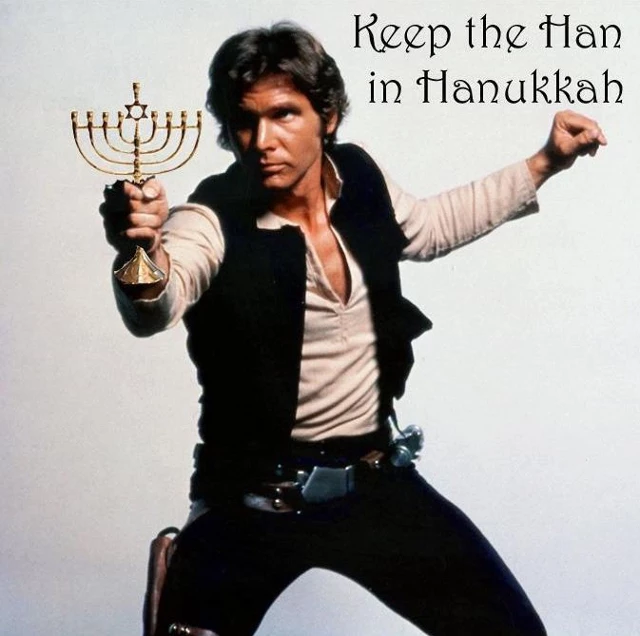
Star Wars Night (because
lightsabres fit with “festival of lights”)

22.
Pet night (give your pets a
gift, and maybe a bath, too)
23.
Focus on your health (take
a walk before lighting candles, do some kind of exercise)
24.
Build a Lego Chanukiah (but
don’t light it)
25.
Do a “White Elephant” gift
exchange with friends
26.
Attend a Chanukah dinner at
your Temple
27.
Try making latkes,
especially unique varieties


28.
Bring in takeout—you need a
break from cooking!
29.
Have your kids “invite” a
stuffed animal or doll for the candlelighting (but keep them away from the flames)
30.
Go through toys or clothes
and donate items that aren’t being used in your home now
31.
Write a letter or a card to
a friend or family member (because nothing replaces “real mail”)
32.
Arrange to spend a night of
Chanukah with someone who doesn’t have family around or offer to drive someone
to services during Chanukah who otherwise wouldn’t be able to attend
I hope that you and your loved ones have a very happy Chanukah!
Sunday, October 26, 2014
The Rainbow, Equality, and Our Children
This month, our family had the opportunity to do two social justice opportunities together. The first was the Atlanta Pride Parade, where we walked with 180 other people representing the Jewish community's support of LGBT equality. This was our daughter's third time in the parade, and our son's first.


Then, this week, Micah and I joined with other clergy in standing in support of marriage equality at a rally hosted by Georgia Equality, asking the state's Attorney General to stop defending the constitutional ban on same-sex marriage. We didn't realize we would be standing behind the podium for the rally and had brought our children. No matter--our family, not just the two rabbis, stood in support (remarkably quiet due to the apple slices and lollipops in my bag--look to the left of the podium).


On the drive home, I reflected with my daughter on our "special mitzvah". She wanted more information so I said, "You know from school that there are many kinds of families. Some people have a mommy and a daddy, some people have just a mommy or just a daddy, and some people have two mommies or two daddies." She replied, "I saw two mommies there." I said, "I did too! That's why were there, to say that all families are special." For my 3 1/2 year old daughter, that made perfect sense.
So many people get nervous about explaining homosexuality or same-sex marriage to their children. I would offer that, just like any other topic in life, if we focus on the basic truths for us and answer the questions being asked, we create an open dialogue and build understanding. I would ask each parent to consider how they explain marriage between a man and a woman to their child, how they help their children to know that single parent-families are families too, and then build messages around this.
In our home, we say all people are special and all families are special. And, at preschool Shabbat this week, teaching the story of Noah, I focused on the image of the rainbow. We counted all the colors represented there, how each had their space and could be seen in the rainbow. In the same way, all people should be seen and loved and given their space, too, because we were all created by and in the image of God.
While this is the preschool-friendly way of explaining diversity, and we will continue to layer more information as appropriate and requested, the reality is that the truth will never change. We will never tell our kids: "Hey, remember when we told you that all people are special and made in the image of God? Well, that was just because you were little." Instead, we can use this idea of all people are equal and deserving of respect to explain racial, religious, and ethnic diversity, why some people are in wheelchairs or have special needs, and any other questions our children's ever-developing brains bring to us. By the time they are adults forming their own opinions, it is our hope that they will always come back to this message, remembering that from their youngest ages, they stood for equality, dignity, and the hope for a better world.
Wednesday, September 17, 2014
A Rabbi's Prayer for the High Holy Days
As a congregational rabbi, there is this pressure to make the High Holy Days perfect. As someone I work with says, "The company is coming!" Our entire staff, from those in charge of the physical plant to those responsible for administration to our educators to our clergy, is busily preparing for the High Holy Days (HHD). It is an overwhelming task to prepare for these sacred days and we want to make sure it is the best experience for our community.
For me, it is important to enter these sacred days intentionally and recognize their significance--both how big they are and how quickly they pass. So, as I enter this final week of preparation, this is my prayer:
O God, I pray that I will enter this season of repentance feeling the fullness of blessings and the awareness of my growing edges.
I pray I will have the internal strength to admit my failings to those I love and respect.
I pray I will have the confidence in myself to step back from my preparation to be home with my family as much as possible, because the work is never done and my family depends upon me too.
I pray I will be able to be mindful and present in the liturgy of these holy days, remembering that to be a rabbi is not to be a performer and I seek to be with the congregation, not above it.
I pray I will remember that the sum total of our Judaism, my rabbinate, or any one congregation is not this one season, but the entire year.
As I pray that this year will be one of blessing and peace, may I be ever mindful that I must act and live in a way to make that a reality.
For me, it is important to enter these sacred days intentionally and recognize their significance--both how big they are and how quickly they pass. So, as I enter this final week of preparation, this is my prayer:
O God, I pray that I will enter this season of repentance feeling the fullness of blessings and the awareness of my growing edges.
I pray I will have the internal strength to admit my failings to those I love and respect.
I pray I will have the confidence in myself to step back from my preparation to be home with my family as much as possible, because the work is never done and my family depends upon me too.
I pray I will be able to be mindful and present in the liturgy of these holy days, remembering that to be a rabbi is not to be a performer and I seek to be with the congregation, not above it.
I pray I will remember that the sum total of our Judaism, my rabbinate, or any one congregation is not this one season, but the entire year.
As I pray that this year will be one of blessing and peace, may I be ever mindful that I must act and live in a way to make that a reality.
Friday, September 12, 2014
Awakening: Everything in its Time
To be the parent of a ten month-old is to be in "watching and waiting" mode. We're watching for tooth #3, we're watching for allergies as he tries new foods, we're watching for signs that he'll pull up, and we're watching for a more even pattern of crawling. Each of these things is, in their own way, an awakening. To watch a (thank God) healthy child's brain wake up in a different way each day, showing another step on the journey of development, is to experience a depth of gratitude and awe unlike anything I have ever experienced.
Yet, waiting for each thing to awaken in its time requires patience and faith. I received a video of my son crawling at day care yesterday. I was delighted to see that he crawled almost across the entire classroom to reach his favorite toy because his crawling is progressing slowly. But I watched as he crawled awkwardly, slithering along using one arm more than the other. I found myself internally whispering, "Wake up...come on, just move your other arm."
Am I worried about him? No, he is a delightfully healthy and sweet baby. I have come to realize that I am just a little impatient sometimes and then lose the faith that everything will unfold in its time (and if it doesn't, we'll cross that bridge when it comes). Every baby website preys upon this part of parents: "just read this and you'll know if everything is normal." Upon reflection, though, I realize that I don't need him to be "normal." What is that concept anyway? What I want is for him to be healthy and to grow in his unique way--not his older sister's way, not the internet's way, but his way. And, I pray that I can find the patience to watch it unfold, to see each piece of his brain, his body, and his soul awaken and connect with us and the world. If I can sit with that patience, and the gratitude and awe which comes with celebrating this awakening, then I will truly love my son as he is, and I will be closer to being the mother I aspire to be.
Yet, waiting for each thing to awaken in its time requires patience and faith. I received a video of my son crawling at day care yesterday. I was delighted to see that he crawled almost across the entire classroom to reach his favorite toy because his crawling is progressing slowly. But I watched as he crawled awkwardly, slithering along using one arm more than the other. I found myself internally whispering, "Wake up...come on, just move your other arm."
Am I worried about him? No, he is a delightfully healthy and sweet baby. I have come to realize that I am just a little impatient sometimes and then lose the faith that everything will unfold in its time (and if it doesn't, we'll cross that bridge when it comes). Every baby website preys upon this part of parents: "just read this and you'll know if everything is normal." Upon reflection, though, I realize that I don't need him to be "normal." What is that concept anyway? What I want is for him to be healthy and to grow in his unique way--not his older sister's way, not the internet's way, but his way. And, I pray that I can find the patience to watch it unfold, to see each piece of his brain, his body, and his soul awaken and connect with us and the world. If I can sit with that patience, and the gratitude and awe which comes with celebrating this awakening, then I will truly love my son as he is, and I will be closer to being the mother I aspire to be.
Thursday, September 4, 2014
Listening and Balancing
The Hebrew word for balance is izun, related to the word ozen (ear), which makes sense since physical balance is linked to our ears.
Internal balance, I believe, is also related to our ears. When we are in balance, we are hearing the competing voices and making sense of them. When we are out of balance, something isn't being heard or given its space. When I find myself out of balance, I know that something is crying out but I cannot listen to it. Sometimes that "something" is my children, asking for my attention. Sometimes it is my work, crammed into less time than it deserves because there are other things happening. Sometimes it is me, with needs for health or space that are not being honored.
Each of us has these voices. The question is how well we listen and how we assign them priority and space. It is not realistic to expect that everything gets heard and fulfilled as we each have limited resources (time being the most precious). Yet, balance is not static. Each day we can listen differently and find a new sense of balance. The more we envision balance as fluid, the more forgiving and flexible we can become.
As I approach the new year, I am praying for the ability to listen. To hear myself, those around me, the voices that are often easily missed in the chaos of life...and in that listening, to find balance.
Subscribe to:
Posts (Atom)