Wednesday, December 3, 2014

32 Ideas for Making Chanukah Meaningful and Fun

Last night, we had a program hosted by our interfaith committee entitled, "How-To Chanukah: Filling Eight Nights with Meaning and Fun." The reality is that all of us, whether we identify as interfaith or not, sometimes struggle to make eight nights interesting and to make the holiday more than candles, gifts, and fried food.

I find it helpful to remember that Chanukah does not need to be hours of celebration every night. For many of us, Chanukah is a 20-30 minute experience (if that). Keep in mind the idea of quality over quantity and remember that the minimum to fulfill the mitzvah is to light the Chanukiah each night.

Further, as much as possible, let's not get into the "Chanukah is just as good as Christmas" competition. Chanukah is not Jewish Christmas and if it were at a different time of year it probably would not be such a big deal in our communities. Instead, let's celebrate Chanukah for what it is. It is a holiday centered around the themes of miracles, light, dedication, Jewish pride, freedom...and oil. It is a holiday that allows us to participate in the broader society through gift-giving, donating, celebrating, and lights. It is one of the only holidays we can celebrate by ourselves in our homes if we so choose. Personally, I appreciate the flexibility of Chanukah. Each night, each year, I can make it what my family needs it to be. Some nights it is a "big deal," and some nights, it is just lighting candles and returning to the weekday joys of dinner, bath, and bedtime.

So, as we all start to think about what we want to do for eight nights of Chanukah this year, I offer you a list of 32 ideas (which could get you through the next four years) compiled at our program last night:

1.       Connect with friends or family (skype or facetime the candlelighting or make time for an extended conversation)
2.       Homemade gifts night
3.       Craft night (do a project, make decorations for your home, go paint pottery)
4.       Game night
5.       Volunteer
6.       Donate (go shopping for gifts for a child in need or spend time researching charitable organizations to make a donation)
7.       See some lights (your neighbors’ lights or more official displays)
8.       Go to a public Chanukiah lighting
9.       Have friends over for dinner
10.   Tell the Chanukah story or watch it on a movie
11.   Make a Chanukah music playlist (Adam Sandler, anyone?)
12.   See how many things you can fry (yes, that's a fried Oreo)

13.   Focus on Israel (give gifts made in Israel, eat Israeli food, etc)
14.   Do an act of social justice (find a rally or meeting around a cause important to you, write a letter to a legislator)
15.   Light some sparklers
16.   Movie Night
17.   Tasting Night (pick an item such as chocolate or wine and taste as many varieties as the night of Chanukah)
18.   Go for Chinese food
19.   Try making a Jewish food you’ve never tried or from a different part of the world
20.   Give Jewish gifts (items of Judaica, books, etc)
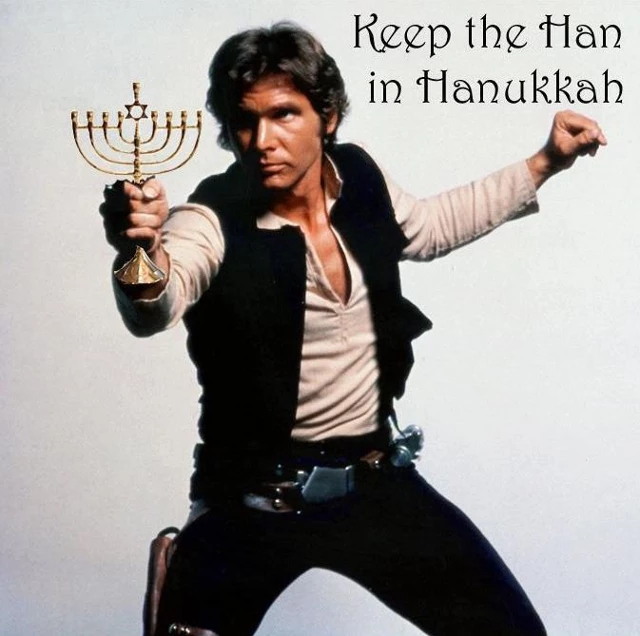
21.   Star Wars Night (because lightsabres fit with “festival of lights”)
22.   Pet night (give your pets a gift, and maybe a bath, too)
23.   Focus on your health (take a walk before lighting candles, do some kind of exercise)
24.   Build a Lego Chanukiah (but don’t light it)
25.   Do a “White Elephant” gift exchange with friends
26.   Attend a Chanukah dinner at your Temple
27.   Try making latkes, especially unique varieties


28.   Bring in takeout—you need a break from cooking!
29.   Have your kids “invite” a stuffed animal or doll for the candlelighting (but keep them away from the flames)
30.   Go through toys or clothes and donate items that aren’t being used in your home now
31.   Write a letter or a card to a friend or family member (because nothing replaces “real mail”)
32.   Arrange to spend a night of Chanukah with someone who doesn’t have family around or offer to drive someone to services during Chanukah who otherwise wouldn’t be able to attend

I hope that you and your loved ones have a very happy Chanukah!

Sunday, October 26, 2014

The Rainbow, Equality, and Our Children

This month, our family had the opportunity to do two social justice opportunities together. The first was the Atlanta Pride Parade, where we walked with 180 other people representing the Jewish community's support of LGBT equality. This was our daughter's third time in the parade, and our son's first.


Then, this week, Micah and I joined with other clergy in standing in support of marriage equality at a rally hosted by Georgia Equality, asking the state's Attorney General to stop defending the constitutional ban on same-sex marriage. We didn't realize we would be standing behind the podium for the rally and had brought our children. No matter--our family, not just the two rabbis, stood in support (remarkably quiet due to the apple slices and lollipops in my bag--look to the left of the podium).


On the drive home, I reflected with my daughter on our "special mitzvah". She wanted more information so I said, "You know from school that there are many kinds of families. Some people have a mommy and a daddy, some people have just a mommy or just a daddy, and some people have two mommies or two daddies." She replied, "I saw two mommies there." I said, "I did too! That's why were there, to say that all families are special." For my 3 1/2 year old daughter, that made perfect sense.

So many people get nervous about explaining homosexuality or same-sex marriage to their children. I would offer that, just like any other topic in life, if we focus on the basic truths for us and answer the questions being asked, we create an open dialogue and build understanding. I would ask each parent to consider how they explain marriage between a man and a woman to their child, how they help their children to know that single parent-families are families too, and then build messages around this. 

In our home, we say all people are special and all families are special. And, at preschool Shabbat this week, teaching the story of Noah, I focused on the image of the rainbow. We counted all the colors represented there, how each had their space and could be seen in the rainbow. In the same way, all people should be seen and loved and given their space, too, because we were all created by and in the image of God.

While this is the preschool-friendly way of explaining diversity, and we will continue to layer more information as appropriate and requested, the reality is that the truth will never change. We will never tell our kids: "Hey, remember when we told you that all people are special and made in the image of God? Well, that was just because you were little." Instead, we can use this idea of all people are equal and deserving of respect to explain racial, religious, and ethnic diversity, why some people are in wheelchairs or have special needs, and any other questions our children's ever-developing brains bring to us. By the time they are adults forming their own opinions, it is our hope that they will always come back to this message, remembering that from their youngest ages, they stood for equality, dignity, and the hope for a better world.


Wednesday, September 17, 2014

A Rabbi's Prayer for the High Holy Days

As a congregational rabbi, there is this pressure to make the High Holy Days perfect. As someone I work with says, "The company is coming!" Our entire staff, from those in charge of the physical plant to those responsible for administration to our educators to our clergy, is busily preparing for the High Holy Days (HHD). It is an overwhelming task to prepare for these sacred days and we want to make sure it is the best experience for our community.

For me, it is important to enter these sacred days intentionally and recognize their significance--both how big they are and how quickly they pass. So, as I enter this final week of preparation, this is my prayer:

O God, I pray that I will enter this season of repentance feeling the fullness of blessings and the awareness of my growing edges.

I pray I will have the internal strength to admit my failings to those I love and respect.

I pray I will have the confidence in myself to step back from my preparation to be home with my family as much as possible, because the work is never done and my family depends upon me too.

I pray I will be able to be mindful and present in the liturgy of these holy days, remembering that to be a rabbi is not to be a performer and I seek to be with the congregation, not above it.

I pray I will remember that the sum total of our Judaism, my rabbinate, or any one congregation is not this one season, but the entire year.

As I pray that this year will be one of blessing and peace, may I be ever mindful that I must act and live in a way to make that a reality.

Friday, September 12, 2014

Awakening: Everything in its Time

To be the parent of a ten month-old is to be in "watching and waiting" mode. We're watching for tooth #3, we're watching for allergies as he tries new foods, we're watching for signs that he'll pull up, and we're watching for a more even pattern of crawling. Each of these things is, in their own way, an awakening. To watch a (thank God) healthy child's brain wake up in a different way each day, showing another step on the journey of development, is to experience a depth of gratitude and awe unlike anything I have ever experienced.

Yet, waiting for each thing to awaken in its time requires patience and faith. I received a video of my son crawling at day care yesterday. I was delighted to see that he crawled almost across the entire classroom to reach his favorite toy because his crawling is progressing slowly. But I watched as he crawled awkwardly, slithering along using one arm more than the other. I found myself internally whispering, "Wake up...come on, just move your other arm."

Am I worried about him? No, he is a delightfully healthy and sweet baby. I have come to realize that I am just a little impatient sometimes and then lose the faith that everything will unfold in its time (and if it doesn't, we'll cross that bridge when it comes). Every baby website preys upon this part of parents: "just read this and you'll know if everything is normal." Upon reflection, though, I realize that I don't need him to be "normal." What is that concept anyway? What I want is for him to be healthy and to grow in his unique way--not his older sister's way, not the internet's way, but his way. And, I pray that I can find the patience to watch it unfold, to see each piece of his brain, his body, and his soul awaken and connect with us and the world. If I can sit with that patience, and the gratitude and awe which comes with celebrating this awakening, then I will truly love my son as he is, and I will be closer to being the mother I aspire to be.

Thursday, September 4, 2014

Listening and Balancing

The Hebrew word for balance is izun, related to the word ozen  (ear), which makes sense since physical balance is linked to our ears. 

Internal balance, I believe, is also related to our ears. When we are in balance, we are hearing the competing voices and making sense of them. When we are out of balance, something isn't being heard or given its space. When I find myself out of balance, I know that something is crying out but I cannot listen to it. Sometimes that "something" is my children, asking for my attention. Sometimes it is my work, crammed into less time than it deserves because there are other things happening. Sometimes it is me, with needs for health or space that are not being honored. 

Each of us has these voices. The question is how well we listen and how we assign them priority and space. It is not realistic to expect that everything gets heard and fulfilled as we each have limited resources (time being the most precious). Yet, balance is not static. Each day we can listen differently and find a new sense of balance. The more we envision balance as fluid, the more forgiving and flexible we can become.

As I approach the new year, I am praying for the ability to listen. To hear myself, those around me, the voices that are often easily missed in the chaos of life...and in that listening, to find balance. 

Friday, August 8, 2014

Carrying Forward A Legacy

Last week, I was in Baltimore where most of my mother's family is buried. We were actually there for my brother's wedding, yet since we are so rarely in Baltimore, it seemed appropriate to take the morning to go to the cemetery as a family.

As I was preparing my three year-old for the visit, I explained that a cemetery is a place where we remember those we love. It is a mitzvah to visit a cemetery and place stones on the graves. So, when we arrived at the cemetery, my daughter immediately set upon the task of finding enough stones for everyone. She was eager to place them where we said and was excited to "do a mitzvah."


I invited her to come over to her great-grandmother Irene's headstone. I was very close to my grandmother and my daughter was named for her. I pointed to the name Irene and asked, "Who do you know who has Irene in her name?" "Me!" my daughter proclaimed. This gave me an opportunity to say that she was named for someone who was brave, who loved family, and who was very special to her mommy and her Savta (grandmother). 

Standing in that cemetery, I was struck by how much my daughter does embody parts of my grandmother. I thought about how my grandmother would always raise her hands in excitement when I arrived for a visit, and how my daughter uses her hands when she wants to make a strong point. I think of my daughter's love of nail polish and how my grandmother did her best to keep a manicure. I think of how my grandmother, when she went into hospice, lamented how she would never see my children. Yet, 6 1/2 years later, I believe she does get to see her children in some way. I could feel in this moment of memory how delighted she would be in them, and in me as a mother. 

When we name our children for family, we are endowing them with a legacy. We are hoping and praying that they will take on the positive qualities of those we love and will maintain a memory for our entire family. In a way, we fulfill an obligation to remember our loved ones by passing on their name, and all that represents. The name, though, is only the first part. It is the stories, the memories, the "wow, your grandma used to do that" moments, that invite our children to actively carry forward this legacy. If we only say, "You were named for our relative," we miss the opportunity to make our children the bearer of a piece of history. 

I stood at the grave of my great-aunt Florence. She was my grandmother's favorite sister and died young. My mother chose to name me for Florence (which is why my name is spelled the way it is). Yet, that's the sum total of the stories I know about Aunt Florence. I never really thought to ask. For my daughter, I had the opportunity to start telling the stories about Grandma Irene in a way that makes sense to a preschooler. I hope that, with time, she will not only know why she was named for Irene, but what her great-grandmother meant to me. My stories will become hers, and then Irene Hurwitz Pollock's legacy and memory truly becomes a blessing. 

Wednesday, July 9, 2014

God is like...

At bedtime last week, as we prepared to sing bedtime Shema, my daughter asked why we say this prayer at night. I said, "Because we are asking God to watch over us." Then came the obvious question, "What's God?"

How does one explain God to a three year old, who still can't separate "today," "tomorrow," and "yesterday," or other abstract concepts? tried a few approaches: "God is something we can't see but can feel...so much bigger than all of us." I then received the question, "Is God a rabbi?" I tried again: "God is like love." Then I said, "God is in our good choices." And then I realized I should exit gracefully: "Let's sing the Shema."

I've spent the nights since then reflecting upon what I know as a rabbi about teaching God and what I now as a parent realize about teaching my children about God and faith. 

When teaching our children about God, the first step as parents is to know what God is to each of us. Everything I said to my daughter about God was true. I do believe that God is present but invisible, felt strongly in the relationships we have, expressed in the choices we make. I feel God's presence as gratitude, the overwhelming feeling of blessing as I look at my children and so many areas of my life. If we as parents don't have a clear sense of some basic truths for us with regard to faith, we will not be able to approach this from a place of confidence or authenticity. 

The next step is to model that knowing. In the moment my daughter asked me about God, I naively thought that I could give one answer that would make perfect sense. She's three, though, and her understanding of faith is more closely tied to her understanding of the parent-child relationship. She can't understand God the way I do....but she can understand that I have faith in God. She can understand that we pray. She can understand that we believe in something greater than ourselves. More powerful than any conversation is what she watches me and others do. 

Those little eyes and ears notice everything! There is a lot of pressure to make sure that what she sees and hears are positive messages. Yet, I would like to think that all of us strive to acheive the best within us, doing our part to bring goodness to this world. So, perhaps this is just another blessing children can bring to our lives--they can be the mirror that reflects who we are and inspires us to be better.