Sunday, May 10, 2015

Mother's Day: A Gift of Time

Mother's Day has always seemed to me a little like Valentine's Day. It is a chance to say thank you, and to make up for all of the other times we didn't say thank you, to our mothers and grandmothers. With the help of the Hallmark industry, there are numerous cards to express these sentiments and a variety of sales to encourage the purchase of extravagant gifts. Like Valentine's day, there is tremendous pressure to "go big." And, like Valentine's day, if you do everything right, it shouldn't be an atonement, just a day of celebration and an excuse to eat chocolate.

Because I usually spend Mother's Day just me and my children (my husband is always leading a trip to Israel), this day is not about gifts or giving Mom a break. I happily accept what my children have made for me (the school gifts improve significantly each year) and then I plan a day which allows me to spend time with my children in very intentional ways. Basically, I plan the day I wish I could do more often but is often taken over with the busyness of work and life. 

Fortunately, Mother's Day is almost as sacred as Yom Kippur and very little is ever scheduled on it. Thus, I have the gift of a whole Sunday to be with my children and (hopefully) not have to think about work. I have planned the day to include an outing to the zoo, a picnic, a nap, time in the backyard sprinkler, and then a Disney movie in our PJs. Dinner may or may not be takeout. 

Mother's Day for me is a gift of a day to focus on being a Mother. It is about the aspirations I have to be fully present in my parenting whenever possible and the joy of just being with my children. I pray that for all who celebrate Mother's Day, in whatever way has meaning for you and your family, it is a day of joy and gratitude. And for those for whom Mother's Day causes pain, I pray there is healing and comfort ahead. 

Now, regardless of how we feel about Mother's Day, may we all enjoy a delicious brunch!

Thursday, April 30, 2015

Why I Baked an Elsa Cake


It took three cake mixes, four tubs of frosting, and at least three hours of my time (not including internet research), but I baked my daughter an Elsa cake for her fourth birthday, which we will begin to observe tomorrow. I discussed the plan with co-workers and then tracked the progress through Facebook, receiving a lot of comments that I'm a "good mom."

And truly, I wish it were that easy to feel like a good mom. I often feel just the opposite, and not primarily because I work full-time (although that stress does play into this). Instead, there are the moments I lose patience, the moments I tire of the questions, the moments I forget how young she is, the moments when I have no idea what to do or say next. She's only (almost) four, and there are times it feels like we are foreshadowing the teenage years. So, to balance these moments of feeling like I fall short, I treasure the moments when I can be the mother I want to be as well as the mother my daughter needs me to be. Those sweet bedtimes, the conversations that are funny and memorable...those are the times that I reassure myself that my daughter and I are going to figure it out, and those sweet and good moments far outweigh the challenging ones.

Enter in the birthday cake. This is the first year my daughter can really engage with her birthday. We have a long list of wants, including an Elsa cake, and I decided to rise to the occasion.

I could have outsourced this (as many do), but something inside of me told me to make this cake. And I realized, while working hard to make it look as smooth as the YouTube video, that I was doing this for a very special reason. Let the grandparents gets her all of the things she wants which one day she will outgrow. I am giving her some of my most precious commodities--my time and my intention. I am saying to her through five layers of cake that I did something other than press "click" on Amazon, I pushed myself to give her something special. I pray one day she will look at that picture and know exactly how funny it is that her mother, who doesn't really bake, made this cake. I pray she will find herself making such a cake for her child and in that instant, be reminded of this sugar and food-dye concoction. Of all of the things from her fourth birthday, I believe she and I will remember looking at this cake and her saying, "Wow, Mommy, I love it!" 

And that is what makes me feel like a good mom. Not the baking, but hearing what my daughter wanted and sharing with her a symbol of my earnest desire to offer it to her. One day, what she wants will be beyond my reach, but for now I will treasure these moments of sweet reward. 

Tuesday, April 28, 2015

Would You Rather?

It's been a while since I've had the opportunity to write on this blog...had to get rid of my gallbladder, prep for Purim and Pesach, and answer my daughter's multitude of questions as she approaches her fourth birthday in a week. This week, I got the parenting "would you rather?": Would you rather the question "How does the baby get in your tummy?" or "Mommy, are you going to die?" Both are challenging questions, reasonable question, and anxiety-provoking questions. But, as I have said in other posts, there are a few strategies to answering your child's tough questions:

-answer the question that is being asked, not the question you are afraid is being asked
-keep it age-appropriate and localized
-keep it honest
-when in doubt, ask him or her "what do you think?"

The "How does the baby get in your tummy?" question came as we were driving in the car in the afternoon. Being a follower of my own advice, I asked her, "What do you think?" to which I was told, "I don't know. You tell me." Trying quickly to sort through what she already knew, wonder what she's already heard, and gauge what the right reaction might be, I said, "Well, that's where babies grow." She said, "but how do they get in there?" And I replied, "When it is time, that is where babies grow, and then they come out. Do you know that the day you were born was very special?" The conversation then shifted to the day she was born and how amazing that was. 

I am not proud that I dodged the question, but having spent the morning's car ride trying to explain the difference between America the country and Captain America the superhero, I was fairly certain that the biological answer was not age-appropriate. I was unprepared for any "seed" metaphors (and am not certain that's what I want to say), so the best approach for me was to shift the conversation to something that is age-appropriate, talking about birth as a special moment for families to celebrate. If nothing else, I have assured my daughter that her birth was a miracle and she has been loved from the first moment we saw her (and before).

Later in the week, my daughter turned to me at the dinner table and asked, "Mommy, are you going to die?" Death has been a topic in our home recently as she has been trying to process some of the pieces of the princess stories which previously went unnoticed. We have told her that death is when a person has to go away and cannot come back, we cannot see the person (except in pictures) and cannot hear the person, but we remember them and think about them and still love them. My answer to her was a simple, "Yes, everyone dies. We pray that they die when they are very, very old." "How old, Mommy?" "Really old, like 100." "Do we get old fast?" "No, it takes a long, long time." 

You and I both know that people can die tragically young, and this week as a rabbi I was made painfully aware of this reality in multiple ways. Yet for my almost-four year old, this is not age-appropriate to discuss. Her first encounter with death is likely to be her great-grandparents and the explanations we have given will hold up in that situation. And, in the painful and tragic event that we need to explain it to her differently, it will be from a place of faith and love. Right now, she is asking from a place of curiosity and probably a little anxiety, so we want to be reassuring on both counts. 

As parents, I believe our responsibility is to try to be honest with our children, and thus be honest with ourselves. I want to make sure I have given true statements, even if they aren't fully answering the question, and I want to encourage asking questions so we have ongoing opportunities to evolve with our answers. Yet, we also have the responsibility of knowing what is age-appropriate, both in offering more information and in offering less. 

I also remember that whatever I say to my daughter about these questions is likely to be held against me in the court of the preschool classroom. Those kids talk, and I want to make sure I don't get a phone call! This is a good reminder that we need to have conversations with our fellow parents about how they are discussing this with their children so we can be respectful and learn together. We might get good ideas for talking with our own children, and also be able to understand where some of the questions (or answers) are coming from. 

Which question would I rather get? I like them both. What I care about is making sure my husband is present for the next time a question is asked!

Prayer for Marriage Equality

As the Supreme Court hears the case on marriage equality in our country, I want to share the prayer we offered this past Shabbat as part of Freedom to Marry weekend of prayer:

When our ancestors stood at the shores of sea, leaving slavery in Egypt behind as they crossed over into a life of freedom, they endowed every subsequent generation with the responsibility to bring that freedom into the world for all. Today, we know that freedom is still an elusive concept, that the struggle for it is real.

The Biblical name for Egypt is Mitzrayim, the narrow place. In any place where people are not free, it is a narrow place. And we acknowledge this Shabbat that our country is still a narrow place because in many states, including our state of Georgia, there is not the freedom of marriage equality. Too many people are oppressed by the narrowness of prejudice, ignorance, fundamentalism, and injustice. We are proud that at The Temple we believe that we are house of prayer to all people, we are a house of prayer and gathering to all couples and families, and that we stand for equality and human dignity.


So we stand on this Freedom to Marry weekend of Prayer, joining with congregations of all faiths around the country in praying that this Tuesday as the Supreme Court hears the case on marriage equality, we begin to bring more freedom to our country. We pray that all who stand on the shores of Mitzrayim, the narrow place of not having equal rights simply because they identity as lesbian, gay, bisexual, or transgender, will find that there will soon be a path towards freedom for them, and thus freedom for us all.

Friday, December 19, 2014

A Reflection on Chanukah

(remarks I am making at services tonight):

It is tempting to think that Chanukah means something different for kids than it does for grownups. After all, we are older, wiser, more learned, and can read. My daughter is convinced that chocolate coins are a Chanukah ritual on par with lighting the candles.

Yes, as grown ups, we know that there are two stories—a story of miraculous military victory and a story of miraculously burning oil. We know that there are complicated notions of assimilation, oppression, and what it means to have religious freedom. We know that we are supposed to publicize the miracle, making this about lights (not about presents).

So, as we prepare for this Chanukah service, I would offer that even if our understanding of Chanukah is a little more evolved than the younger generation’s, both of us have something to learn from one another:

As we welcome this Shabbat of Chanukah, may we remember that as we have much to teach to our children, we also have much to learn from them.

When we light the candles, knowing that the story of the oil lasting for 8 nights came much later than the story of the military victory…may we remember that it doesn’t always matter which came first, which one is right, or whether it is true…sometimes the story is  a good story, and that’s enough.

When we bless miracles that happened then and now, may we remember with a child’s sense of wonder that miracles are present in our world if we look and define in the right way.

When we celebrate Chanukah amidst a predominantly Christmas-focused society, let’s not deceive ourselves into thinking that we outgrow the challenge of being a minority.

When we eat the latkes, the sufganiyot, the chocolate coins…let’s not talk about our diets just for a minute and instead pretend we have a child’s metabolism. And then take a walk.

When we give and receive gifts, let’s remember that while Chanukah is not really about presents, they’re fun and that’s okay at any age.

When we look at the Chanukah candles, glowing with increasing light each night, we pray that we increase in holiness, from childhood to adulthood, from year to year, from day to day. And let us remember that we can bring light to the world at any age and in so many ways. Let us never dismiss the smallest lights among us.

Let us remember that Chanukah is a time for pride, for freedom, for believing in miracles in those days and in ours. It isn’t that complicated, it isn’t that hard, and we have 8 days to try to get it right each year.  

Monday, December 15, 2014

Chocolate vs. Candles

This morning I found myself in a debate with my 3 1/2 year old daughter. When I said that Chanukah starts tomorrow evening and we'll have fun lighting candles and exchanging gifts, she said, "And eating chocolate coins." I said, "Well, we can do that too, but we're going to have so much fun playing dreidel and eating latkes," and she said, "And eating chocolate coins." In a last-ditch effort to emphasize the true meaning of Chanukah, I said, "The only thing we have to do is light the candles--the rest is just fun." And she replied, "But we have to eat chocolate coins."

At her Jewish preschool, and then at a Chanukah event at a Jewish day school, my daughter tasted chocolate coins. Now, it is abundantly clear that more than candles, latkes, and gifts, the true spirit of Chanukah can be expressed through chocolate.

This entire day I have been wrestling with that all-important parenting question: Why do I care? It is not the measure of my worth as a Jewish mother or rabbi whether my preschooler cares more about chocolate coins than lighting the candles. I have to trust that she will enjoy the aspects of the holiday as they unfold--candles, foods, gifts, programs with our Temple, dinners with friends. Chocolate coins will be just one part of a constellation of treats and joys during these eight days.

My answer, as best I can figure, is that I forget she is only 3. She speaks so clearly, seems to understand (or at least hear) so much, so I find myself surprised when she says something that is so clearly her age.

I could make this about me, or I could make this about her. This is probably the first Chanukah she will really remember--so I'm going to make it fun, special, and truly on her level. I imagine that if I make this a fun Chanukah for her, it will be my best Chanukah yet!

Now, you can be sure I am off to the store to buy some chocolate coins :-)


Wednesday, December 3, 2014

32 Ideas for Making Chanukah Meaningful and Fun

Last night, we had a program hosted by our interfaith committee entitled, "How-To Chanukah: Filling Eight Nights with Meaning and Fun." The reality is that all of us, whether we identify as interfaith or not, sometimes struggle to make eight nights interesting and to make the holiday more than candles, gifts, and fried food.

I find it helpful to remember that Chanukah does not need to be hours of celebration every night. For many of us, Chanukah is a 20-30 minute experience (if that). Keep in mind the idea of quality over quantity and remember that the minimum to fulfill the mitzvah is to light the Chanukiah each night.

Further, as much as possible, let's not get into the "Chanukah is just as good as Christmas" competition. Chanukah is not Jewish Christmas and if it were at a different time of year it probably would not be such a big deal in our communities. Instead, let's celebrate Chanukah for what it is. It is a holiday centered around the themes of miracles, light, dedication, Jewish pride, freedom...and oil. It is a holiday that allows us to participate in the broader society through gift-giving, donating, celebrating, and lights. It is one of the only holidays we can celebrate by ourselves in our homes if we so choose. Personally, I appreciate the flexibility of Chanukah. Each night, each year, I can make it what my family needs it to be. Some nights it is a "big deal," and some nights, it is just lighting candles and returning to the weekday joys of dinner, bath, and bedtime.

So, as we all start to think about what we want to do for eight nights of Chanukah this year, I offer you a list of 32 ideas (which could get you through the next four years) compiled at our program last night:

1.       Connect with friends or family (skype or facetime the candlelighting or make time for an extended conversation)
2.       Homemade gifts night
3.       Craft night (do a project, make decorations for your home, go paint pottery)
4.       Game night
5.       Volunteer
6.       Donate (go shopping for gifts for a child in need or spend time researching charitable organizations to make a donation)
7.       See some lights (your neighbors’ lights or more official displays)
8.       Go to a public Chanukiah lighting
9.       Have friends over for dinner
10.   Tell the Chanukah story or watch it on a movie
11.   Make a Chanukah music playlist (Adam Sandler, anyone?)
12.   See how many things you can fry (yes, that's a fried Oreo)

13.   Focus on Israel (give gifts made in Israel, eat Israeli food, etc)
14.   Do an act of social justice (find a rally or meeting around a cause important to you, write a letter to a legislator)
15.   Light some sparklers
16.   Movie Night
17.   Tasting Night (pick an item such as chocolate or wine and taste as many varieties as the night of Chanukah)
18.   Go for Chinese food
19.   Try making a Jewish food you’ve never tried or from a different part of the world
20.   Give Jewish gifts (items of Judaica, books, etc)
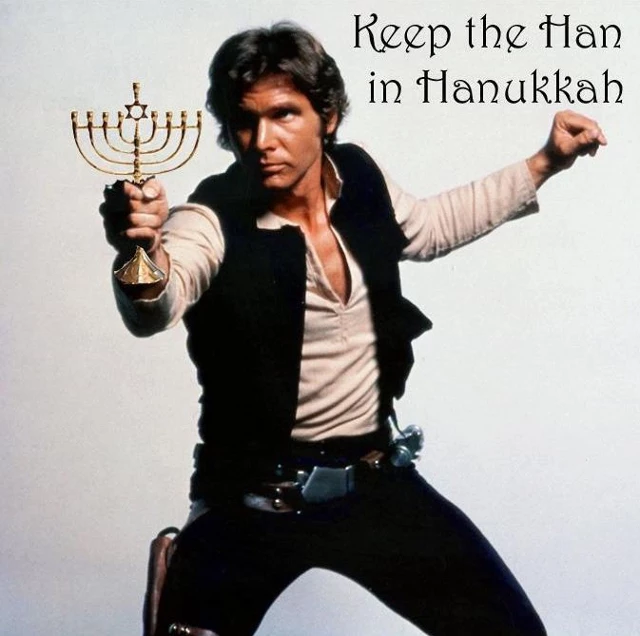
21.   Star Wars Night (because lightsabres fit with “festival of lights”)
22.   Pet night (give your pets a gift, and maybe a bath, too)
23.   Focus on your health (take a walk before lighting candles, do some kind of exercise)
24.   Build a Lego Chanukiah (but don’t light it)
25.   Do a “White Elephant” gift exchange with friends
26.   Attend a Chanukah dinner at your Temple
27.   Try making latkes, especially unique varieties


28.   Bring in takeout—you need a break from cooking!
29.   Have your kids “invite” a stuffed animal or doll for the candlelighting (but keep them away from the flames)
30.   Go through toys or clothes and donate items that aren’t being used in your home now
31.   Write a letter or a card to a friend or family member (because nothing replaces “real mail”)
32.   Arrange to spend a night of Chanukah with someone who doesn’t have family around or offer to drive someone to services during Chanukah who otherwise wouldn’t be able to attend

I hope that you and your loved ones have a very happy Chanukah!